Noodle Flour Sheet Smoothness and Cooking Loss Checks
Mill-side variables to review when noodle flour drifts on sheet smoothness, bite, cooking loss, and customer specification consistency.
Request pricing Mill-side variables to review when noodle flour drifts on sheet smoothness, bite, cooking loss, and customer specification consistency.
Request pricingNoodle customers often report the problem at the line: rough sheets, weak bite, surface sloughing, cloudy cooking water, or cooking loss that drifts beyond their internal target. For the flour mill, the correction should start upstream, before assuming the noodle plant needs another process adjustment.
Flour treatment for noodles is not about masking poor grist or forcing one recipe across every wheat position. It is about understanding which mill-side variables are moving, then applying precise treatment only where it supports specification stability.
For quality managers, the practical question is simple: is the noodle issue coming from wheat, milling, flour functionality, enzyme balance, or a combination?
Noodle dough is unforgiving because sheet formation exposes small changes in flour. A flour that looks acceptable on a standard certificate can still behave differently under compression, rest, cutting, and cooking.
Common customer complaints include:
The mill’s task is to separate formulation noise from true flour functionality. That means checking the base flour first, then deciding whether enzyme treatment is a useful correction.
For noodle flour, the grist is not only a cost and availability decision. It determines gluten character, starch damage tendency, flour color, and water behavior.
A blend can hold the same nominal protein while changing in gluten strength, extensibility, and hydration response. That is where noodle customers feel the drift: the sheet may become tight and prone to cracking, or slack and prone to sticking.
Check whether recent wheat substitutions have changed:
Noodle sheet smoothness is visibly sensitive to fine bran contamination and ash drift. A small shift in purification, roll setting, or sifter performance can show up as surface roughness or darker specking, especially in pale noodle styles.
Review:
If the root issue is ash or speck control, enzyme treatment cannot replace milling discipline. Treatment can support dough handling, but it should not be used to cover preventable stream contamination.
Starch damage is one of the most common causes of noodle flour surprises. Too little functional water binding can reduce sheet body; too much can increase stickiness, slow hydration balance, and change cooked texture.
Watch for signs such as:
When starch damage changes because of wheat hardness or mill setting, treatment choice should be reviewed. A flour that needs structure support is different from a flour that needs improved water management.
Noodle dough responds to flour granulation because hydration rate affects sheet formation. A fine shift can change the way dough comes together, relaxes, and releases from rolls.
Look at whether the flour is hydrating too quickly at the surface, forming uneven dough, or requiring more rest to reach workable sheeting behavior. These issues may appear at the customer as rough sheets, inconsistent thickness, or poor edge definition.
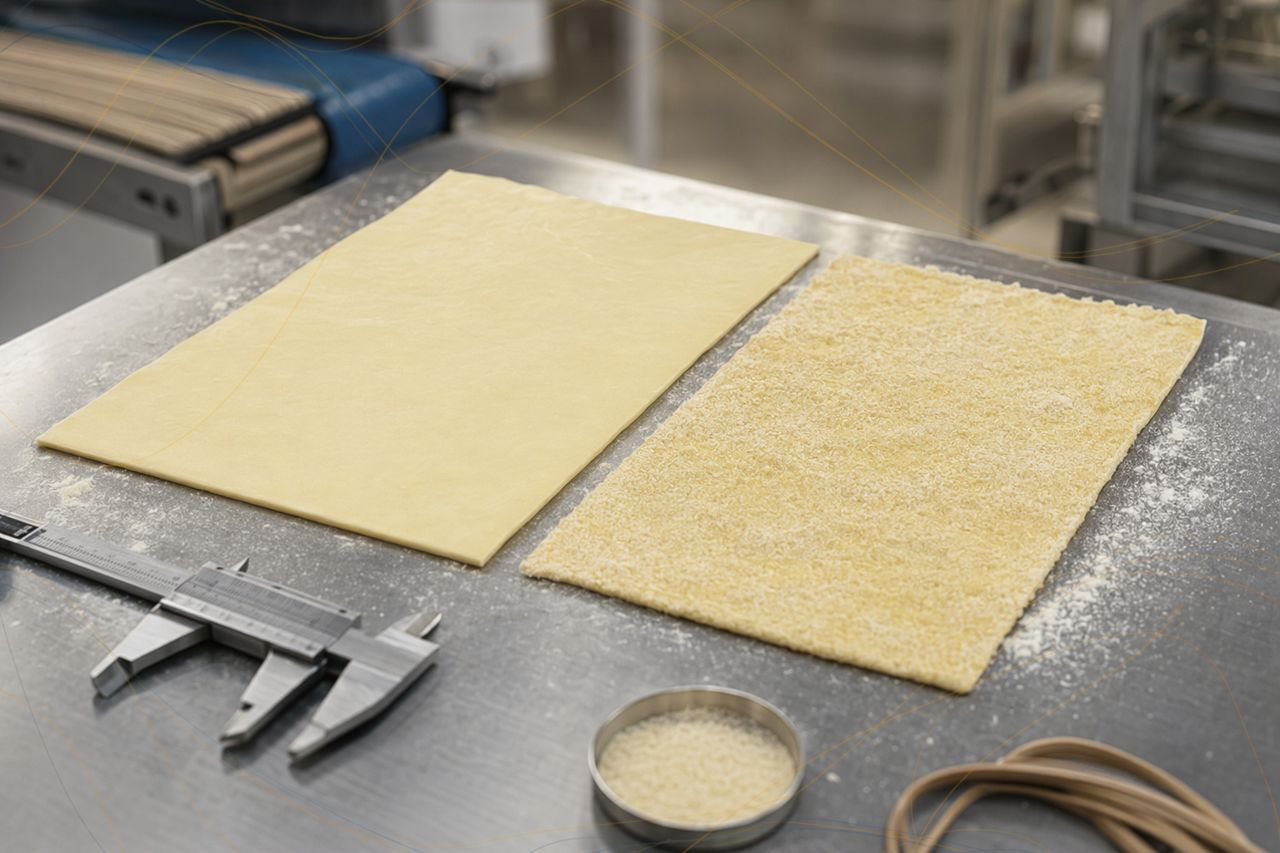
A smooth noodle sheet needs enough elasticity to resist tearing, but enough extensibility to pass through reduction without surface fracture. If the dough is too tight, the sheet can crack. If it is too slack, it can stretch unevenly, stick, or lose bite after cooking.
This is where enzyme treatment can be valuable, provided the base flour is close to target. The goal is not maximum reaction. The goal is controlled, repeatable dough behavior.
Aleuron Works approaches noodle flour treatment as a mill-side adjustment, not a generic additive decision. The right enzyme system depends on the defect pattern and the customer’s noodle process.
Potential treatment directions may include:
The most useful enzyme blend is the one that improves the customer’s line behavior without pushing the flour outside agreed ash, protein, color, absorption, or handling expectations.
Before running a treatment trial, define the problem clearly. A vague target such as better noodle quality is too broad. A useful target sounds like: smoother sheet at the third reduction, less roll pickup after rest, firmer bite after cooking, or lower visible cooking loss.
A mill-side validation plan should include:
The best trials do not only ask whether the enzyme works. They ask whether the treatment is robust enough for normal wheat variation and practical enough for the mill’s dosing system.
Bring Aleuron Works in when the mill has a defined noodle flour issue and wants a disciplined way to evaluate treatment. We are most useful when quality, production, and commercial teams need a clear link between flour variables, customer complaints, and treatment decisions.
Good starting information includes:
As an enzyme supplier for flour mill treatment, Aleuron Works supports practical trial design, treatment selection, and scale-up discussion for flour producers serving noodle manufacturers.
Noodle sheet smoothness, bite, and cooking loss usually move for a reason. The faster the mill can connect the complaint to grist, milling, flour behavior, and treatment response, the faster it can protect customer confidence.
If your noodle flour is drifting against customer expectations, use the on-site request a quote form to share the flour type, noodle application, and the defect you need to correct. Aleuron Works will respond with a treatment discussion and trial pathway tailored to your mill.
Tell us your application and volume — we reply with pricing and lead time.