A Quality Manager’s Guide to Customer Complaint Triage for Flour Mills
A customer complaint is rarely caused by one variable. In flour milling, the symptom may arrive as sticky dough, weak tolerance, tight volume, excessive snap-back, poor machinability, or inconsistent crumb. But the source can sit anywhere across wheat intake, tempering, extraction, ash drift, protein quality, starch damage, flour age, additive dosing, packaging, storage, customer handling, or bakery process control.
For quality managers, the priority is not to defend the mill or guess at a treatment. The priority is to triage quickly, preserve evidence, and separate flour-side causes from process-side causes before the complaint becomes a specification dispute.
Aleuron Works supports mills that need enzyme treatment decisions to sit inside this disciplined complaint process. As an enzyme supplier for flour mill treatment, we focus on practical dosage control, trial validation, and repeatable customer outcomes—not generic additive recommendations.
Start with the complaint in the customer’s language
The first intake step should capture the issue exactly as the customer experiences it. Avoid translating too early into mill terminology.
Ask for:
- Product name, flour code, lot number, delivery date, and packaging format
- Complaint description in operational terms: mixing time, dough stickiness, extensibility, volume, proof stability, sheeting behavior, crumb, crust, or bite
- Whether the issue appeared suddenly or drifted over multiple deliveries
- Photos, bake records, mixer settings, dough temperatures, water additions, fermentation times, and line speed changes
- Retained flour and finished product samples where available
- Whether other flour suppliers or flour lots performed differently on the same line
A complaint that says “the dough is weak” can mean reduced gas retention, excessive extensibility, poor resistance, low absorption, over-relaxation, or a process shift at the bakery. The first job is to make the symptom measurable.
Build a triage file before changing treatment
A rapid treatment change may satisfy urgency, but it can also mask the real cause. Before adjusting an enzyme system, build a triage file around the affected lot.
Minimum mill-side review
- Wheat grist composition used for the lot
- Tempering targets and actual moisture behavior
- Extraction rate and any operational deviation
- Ash result and trend position against normal range
- Protein level and protein quality indicators used by the mill
- Moisture, falling number trend, damaged starch indicators, and flour age
- Sifter, purifier, roll, and blending notes from the production window
- Additive and micro-dosing records, including hopper status, feeder checks, and changeover timing
- Retain sample condition and storage history
Minimum customer-side review
- Formula and process changes during the complaint period
- Water addition and dough temperature trend
- Mixer energy or mixing time changes
- Fermentation, proofing, sheeting, or make-up line conditions
- Flour storage temperature, humidity exposure, and first-in-first-out control
- Whether the complaint follows one line, one shift, or one product only
This structure helps prevent an enzyme correction from being applied to a non-enzyme problem.
Map symptoms to likely flour-side variables
The complaint symptom should guide the investigation, not replace it. Use symptom mapping to prioritize the next test or customer trial.
Sticky or slack dough
Possible flour-side contributors:
- Higher damaged starch than expected
- Absorption mismatch against customer water setting
- Excessive dough relaxation from treatment imbalance
- Flour age or storage conditions affecting handling
- Wheat quality shift affecting protein strength
Practical triage move: compare retain and current production flour in a controlled dough test using the customer’s water level and mixing profile. Do not judge stickiness from standard lab handling alone if the customer runs a high-speed line.
Low loaf volume or poor oven spring
Possible flour-side contributors:
- Insufficient fermentable sugar release for the customer process
- Protein strength or extensibility mismatch
- Overly tight dough limiting expansion
- Flour enzyme balance not aligned with fermentation time
- Process-side under-proofing or thermal variation
Practical triage move: run side-by-side baking or application testing with the complaint lot, a retained accepted lot, and a calibrated treatment adjustment. Record both dough behavior and finished product dimensions.
Excessive snap-back or tight sheeting behavior
Possible flour-side contributors:
- High resistance relative to extensibility
- Insufficient relaxation for the application
- Protein quality shift masked by similar protein percentage
- Treatment level not matched to customer line speed
Practical triage move: avoid using protein percentage as the deciding metric. Two flours with similar protein can behave very differently under sheeting stress.
Gummy crumb or poor sliceability
Possible flour-side contributors:
- Starch damage and water management mismatch
- Enzyme balance affecting crumb softness or moisture distribution
- Underbake or cooling change at the customer site
- Flour age and storage interaction
Practical triage move: separate crumb structure, moisture perception, and actual process records. A gumminess complaint is often shared between flour behavior and bakery thermal control.
Check dosing control before reformulating
If the affected flour includes treatment, verify dosing control before changing the formula. A treatment design can be sound while the delivery system is drifting.
Review:
- Feeder calibration records and recent maintenance
- Ingredient flow characteristics in the dosing hopper
- Bridging, rat-holing, vibration, humidity exposure, and refill practices
- Changeover timing between treated and untreated flour streams
- Blending uniformity and production run length
- Lot traceability from treatment premix to finished flour
For complaint investigations, dosage confidence is as important as dosage selection. If the mill cannot confirm that the intended level reached the flour consistently, the corrective action should start with control, not chemistry.
Do not let ash and protein averages hide functional drift
Customer complaints often occur when headline specifications remain in range. Ash may be acceptable. Protein may meet contract. Moisture may be normal. Yet dough behavior still shifts.
Quality managers know why: flour functionality depends on more than average specification values.
Watch for:
- Protein quality changes within the same protein band
- Extraction changes that alter bran impact and ash distribution
- Starch damage movement that affects absorption and mixing behavior
- Wheat blend changes that alter extensibility and resistance
- Flour age differences between retained sample, dispatch, and customer use
Enzyme treatment should be validated against functional behavior, not just paper specifications. This is especially important for mills supplying bakeries with tight process windows, automated lines, or regional flour expectations.
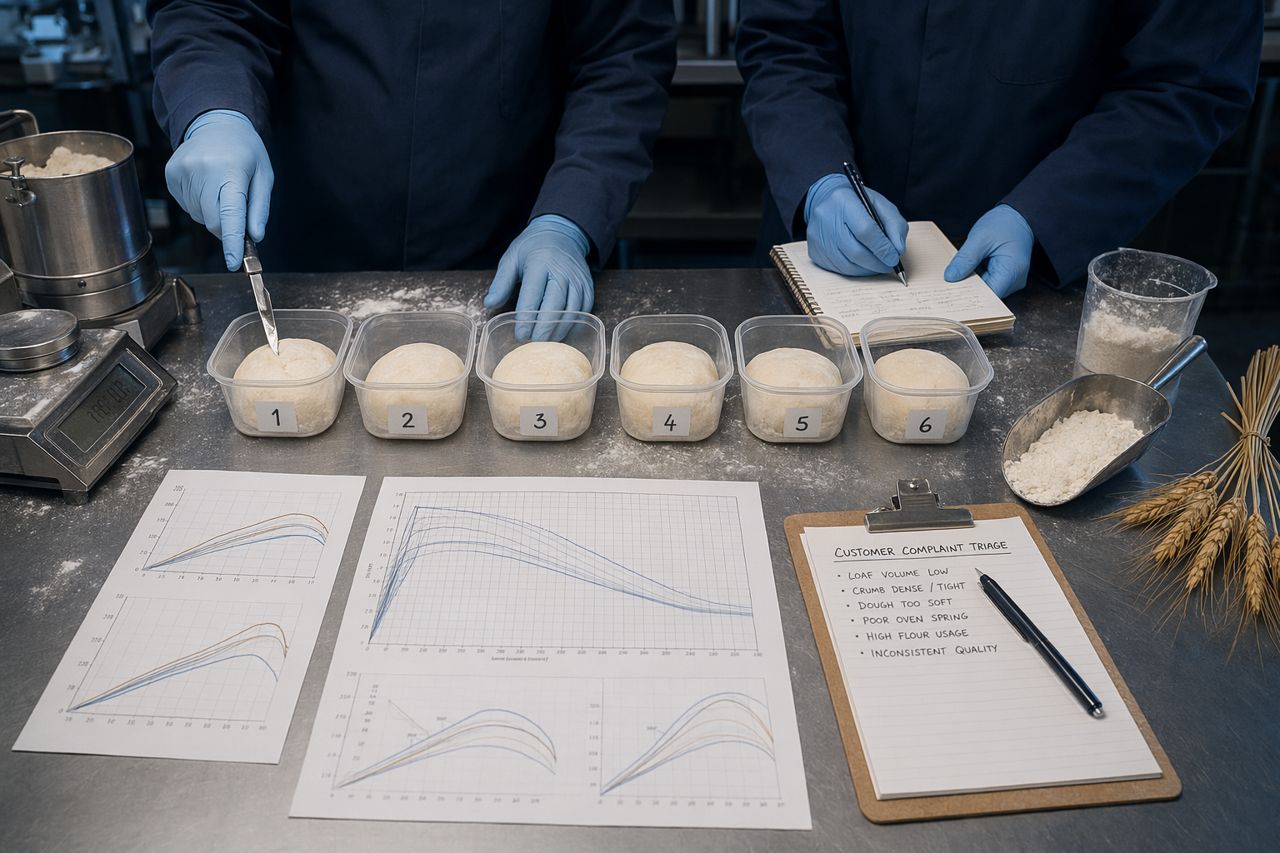
Use a three-sample trial structure
When enzyme treatment is part of the potential corrective action, avoid a single comparison. A three-sample structure gives better decision confidence.
1. Complaint lot
This shows the customer’s reported baseline. Test under the customer’s process conditions where possible.
2. Accepted reference lot
This provides the performance target. It is more useful than a generic flour standard because it reflects what the customer previously accepted.
3. Calibrated adjustment sample
This applies a measured treatment adjustment designed around the symptom: dough relaxation, fermentation support, handling stability, volume, crumb softness, or line tolerance.
The goal is not to make the strongest possible effect. The goal is to return the flour to the customer’s operating window with the least disruptive correction.
Where enzyme treatment fits in complaint resolution
Enzyme systems can help a flour mill correct functional gaps that are difficult to manage through grist or extraction changes alone. They may support:
- More stable dough handling across wheat variation
- Improved fermentation performance where the process needs support
- Better extensibility for sheeting and moulding
- Crumb softness and eating quality targets
- Reduced customer variation from lot to lot
- Practical correction when wheat quality shifts faster than customer specifications can be renegotiated
But enzyme treatment should not be treated as a universal fix. It works best when the mill has a clear symptom, confirmed process context, reliable dosing, and a trial plan that mirrors customer use.
Complaint response template for quality teams
Use this internal sequence before issuing a corrective action.
-
Log the complaint precisely
Capture customer language, product, lot, timing, and production context.
-
Secure evidence
Hold retain samples, treatment records, dispatch data, and customer samples if available.
-
Compare against accepted performance
Do not rely only on contract specifications. Include functional comparison.
-
Check dosing and blending control
Confirm the treatment that was specified is the treatment that was delivered.
-
Run targeted application testing
Replicate the customer process as closely as possible.
-
Trial the smallest credible correction
Validate treatment adjustment against the complaint lot and reference lot.
-
Document the decision
Record what changed, why it changed, expected outcome, and monitoring plan.
-
Close the loop with the customer
Explain the corrective action in operational terms the bakery can verify.
What a strong corrective action looks like
A strong response is specific, measured, and traceable.
Weak corrective action: “Adjusted enzyme level to improve dough.”
Stronger corrective action: “Complaint lot showed higher relaxation than the accepted reference under the customer’s mixing and sheeting conditions. Dosing records were verified. A calibrated treatment adjustment was tested against the retained complaint lot and restored dough resistance and line handling to the agreed reference range. Next three production lots will be monitored against the same application test.”
This type of response protects the mill because it connects the complaint, evidence, action, and verification.
How Aleuron Works supports flour mill complaint triage
Aleuron Works works with flour mills that need enzyme treatment to be controlled, defensible, and aligned with customer specifications. We help quality and production teams evaluate complaint patterns, design mill-appropriate treatment trials, and translate dough behavior into practical corrective action.
Our support is built around:
- Flour functionality and customer application context
- Treatment selection for the specific complaint pattern
- Dosage control and production practicality
- Side-by-side trial structures using complaint and reference lots
- Documentation that quality managers can use in customer communication
If your mill is managing recurring complaints around dough handling, fermentation response, volume, softness, or lot-to-lot consistency, we can help structure the next trial before you commit to a permanent change.
Request a quote for flour mill enzyme treatment support and include the complaint pattern, flour type, customer application, and current specification targets.