Why finished flour improver blends are hard to debug in mill QA
Finished flour improver blends are often adopted for good reasons: a customer needs better dough handling, a bakery wants more processing tolerance, or a flour line needs a fast correction without disrupting the mill. But once a finished blend becomes part of routine release, it can make quality troubleshooting harder.
For a flour mill QA team, the issue is not whether improvers work. The issue is whether the mill can explain what changed when a specification moves, a bake result drifts, or a customer complaint arrives.
Aleuron Works works with mills that want enzyme treatment to behave like a controlled milling adjustment: targeted, trial-validated, dosage-aware, and traceable against flour realities such as ash, protein, starch damage, moisture, extraction, and seasonal wheat behavior.
If you are evaluating an enzyme supplier for flour mill treatment, the key question is not only “what improves the flour?” It is also “can we debug the improvement when the flour changes?”
The debugging problem: finished blends combine too many variables
A finished improver blend may contain several functional components intended to influence dough strength, fermentation response, loaf volume, crumb softness, machinability, or tolerance during processing.
That broad coverage can be useful. It can also make investigation difficult.
When a finished flour blend is underperforming, QA may need to answer several questions at once:
- Did the wheat mix change?
- Did extraction or ash movement shift?
- Did protein quantity or protein quality change?
- Did starch damage move outside the usual range?
- Is moisture affecting handling or storage behavior?
- Has flour age changed the bake response?
- Is the customer using the same process and formulation?
- Is the improver dosage stable and correctly dispersed?
- Is one functional component helping while another is creating a new issue?
With a broad finished blend, the mill may see the symptom but not the driver.
A dough may become too slack, too tight, too short, too sticky, too tolerant, not tolerant enough, or inconsistent across production days. Without a more segmented treatment strategy, it is difficult to know whether the cause sits in the flour, the improver, the dosage, the customer process, or the interaction between them.
Why flour mill QA needs more than a pass/fail bake result
Bake testing is essential, but a single pass/fail result rarely explains why the flour behaved the way it did.
A finished improver blend can make the final bake look acceptable while still masking an unstable flour base. That may be fine until one of the following changes occurs:
- A tighter customer specification is introduced
- A bakery changes processing speed or fermentation time
- Wheat supply moves into a different crop profile
- Extraction targets are adjusted for yield
- Ash or protein drifts within a technically acceptable but functionally sensitive range
- The customer adds a new product format with less tolerance for variation
In these cases, the mill may discover that the improver was not only correcting a known issue. It was also hiding a flour behavior that had never been fully mapped.
This is why Aleuron Works emphasizes trial design before routine adoption. A flour treatment system should not only improve today’s sample. It should help QA understand where the working range begins, where it ends, and what warning signs to watch when wheat or milling conditions change.
Common QA symptoms that finished blends can obscure
Dough strength changes that do not track cleanly with protein
Protein matters, but protein alone does not explain dough behavior. Finished blends can complicate the picture by changing extensibility, tolerance, and handling in ways that make protein-based expectations less reliable.
A mill may see two flours with similar protein levels perform differently under the same blend. If the improver is treated as a single black-box input, QA has limited visibility into whether the issue is gluten quality, enzyme response, starch damage, flour age, or blend dosage sensitivity.
Volume improvement with handling penalties
A blend may help loaf volume while increasing stickiness, reducing machining stability, or narrowing the customer’s process window. If the customer values line stability as much as volume, the mill needs a more balanced treatment plan.
The question becomes: which function is creating the gain, and which function is creating the penalty?
Crumb softness that varies by customer process
Softness targets often depend on bakery formulation, fermentation profile, packaging timing, and shelf-life expectations. A finished blend may appear reliable in one bake test but show different behavior in a customer’s actual process.
A targeted trial should separate immediate bake response from later texture expectations, so the mill does not overcorrect one parameter while missing another.
Tolerance claims that are hard to confirm
“Tolerance” is useful only when it is defined. Mixing tolerance, fermentation tolerance, sheeting tolerance, proofing tolerance, and oven response are not the same operating condition.
Finished blends can make tolerance sound simple. Mill QA knows it is not.
The dosage issue: small process errors become large interpretation errors
Improver dosage control is one of the most practical debugging points in a flour mill.
Even a well-designed improver can look inconsistent if dosing equipment, pre-blending, addition point, flour flow, or operator practice creates variation. The difficulty with finished blends is that a dosage error changes several functional inputs at once.
That means a small handling issue can appear as a complex flour performance problem.
Aleuron Works approaches dosage as part of the treatment system, not an afterthought. For a mill-floor trial, the dosage window should be realistic for the plant, measurable by routine production controls, and reviewed against the flour’s own variability.
A treatment that only works in a narrow theoretical range may not be suitable for a high-throughput mill with daily wheat variation and customer-specific release pressure.
A better approach: modular enzyme treatment with trial discipline
The alternative to a black-box finished blend is not complexity for its own sake. It is controlled separation of functional targets.
Aleuron Works helps mills evaluate enzyme treatment by defining the main performance objective first, then building a trial plan around the flour and customer requirement.
Typical targets may include:
- Improved dough handling without excessive slackening
- More stable fermentation response
- Better processing tolerance for industrial bakery lines
- Crumb softness support for packaged bread applications
- Volume improvement while respecting customer texture expectations
- Reduced variation across crop transition periods
- More predictable performance across customer bake tests
The goal is not to add more ingredients. The goal is to make each adjustment understandable.
When the mill knows which treatment is intended to influence which outcome, QA can investigate more cleanly. If the bake result changes, the team can compare flour analytics, dough behavior, dosage records, and customer processing notes against a defined treatment hypothesis.
What a practical mill trial should include
A useful flour treatment trial should be built around real mill conditions, not idealized bench assumptions.
1. Baseline flour profile
Start with the flour as it actually ships: extraction target, ash range, protein range, moisture, starch damage context, flour age, and customer application. The baseline should be clear enough that the team knows whether future changes are treatment-driven or flour-driven.
2. Defined customer performance target
“Better flour” is not precise enough. The trial should name the desired change: dough stability, reduced stickiness, improved volume, softer crumb, stronger machining tolerance, or a more consistent response in a specific bakery format.
3. Realistic dosage window
The treatment must be controllable in the mill. Trial levels should reflect practical dosing and blending conditions, not a range that cannot be maintained during production.
4. Side-by-side bake and dough evaluation
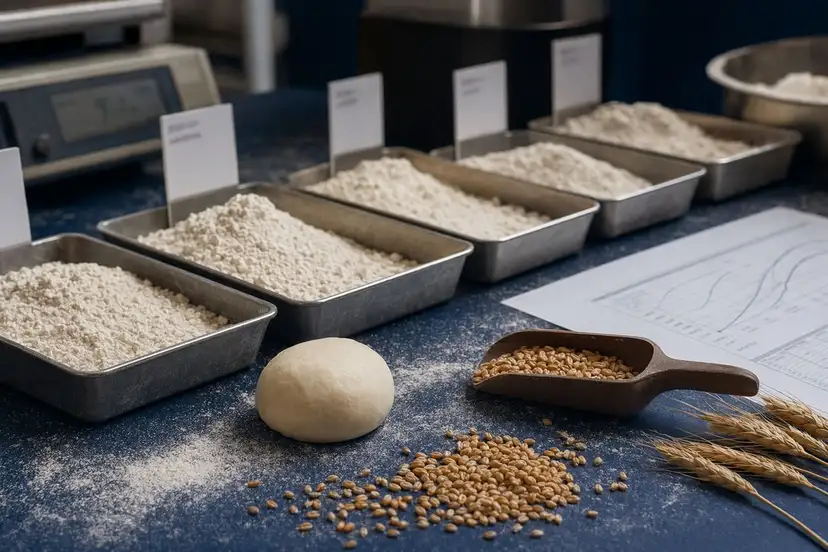
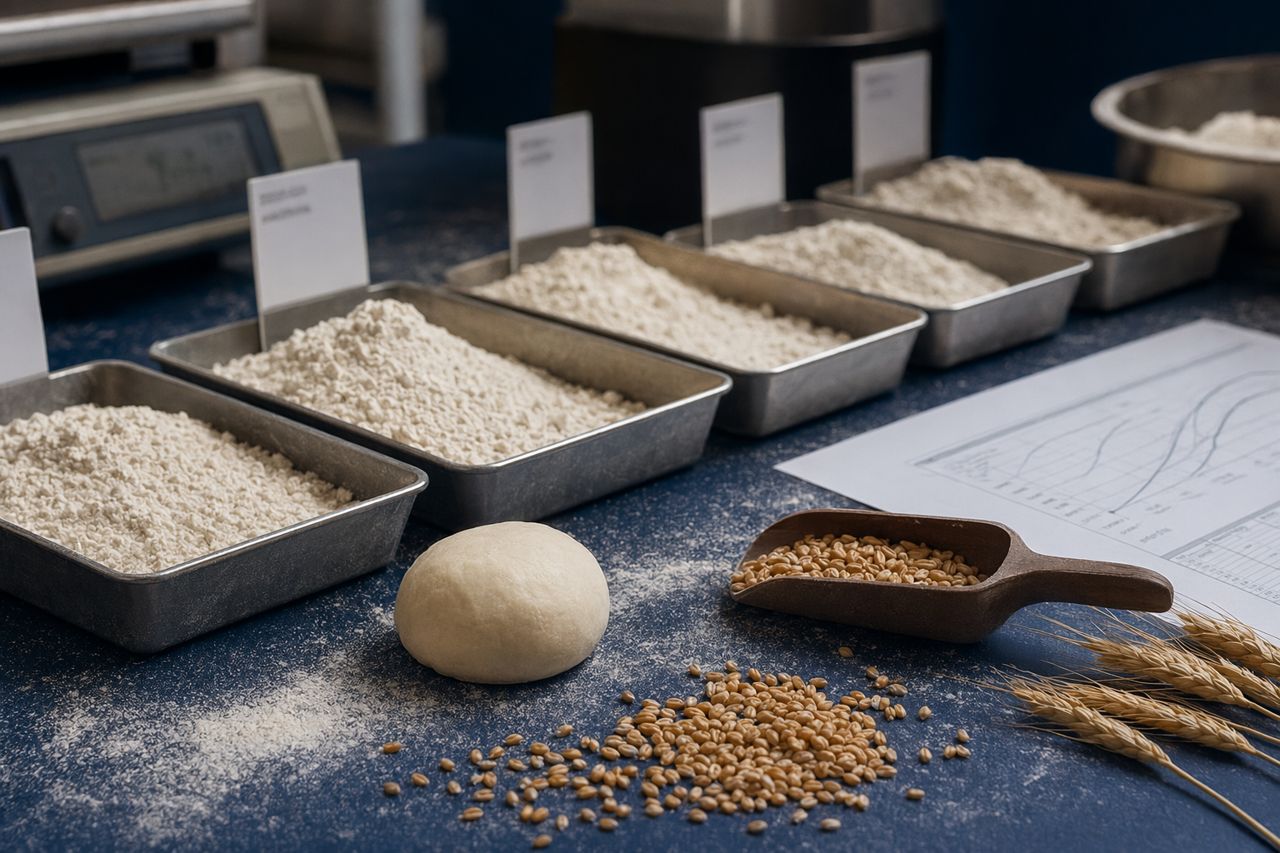
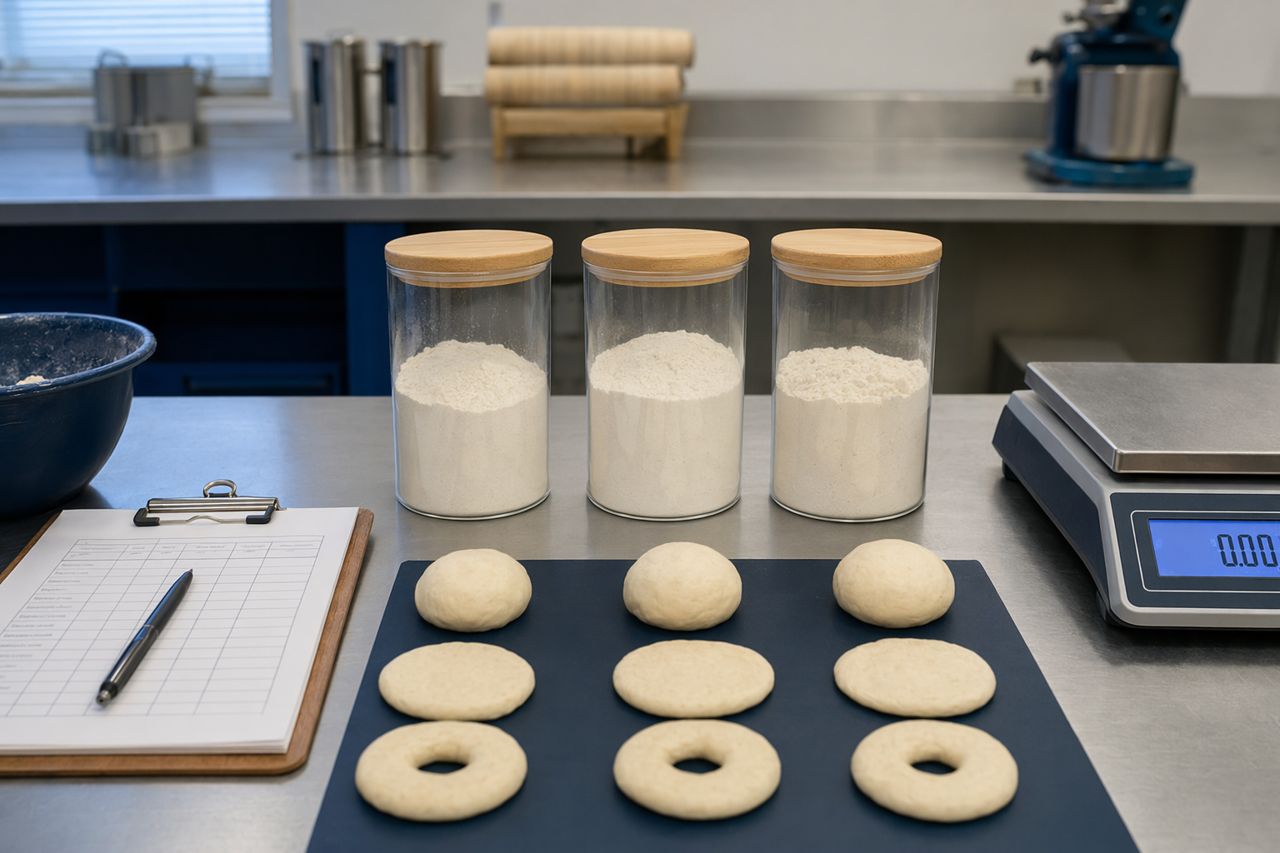
QA should compare untreated flour, current finished blend, and proposed treatment under consistent conditions. Where relevant, customer-side process confirmation should be included before commercial release.
5. Release criteria before scale-up
Before adoption, agree on what success looks like. That may include bake performance, dough handling notes, customer acceptance, production feasibility, and evidence that the treatment remains stable across normal flour variation.
Where Aleuron Works fits
Aleuron Works supplies enzyme solutions for flour mill treatment with a focus on practical QA control, not generic improver language.
We support mills that need:
- A clearer alternative to broad finished flour improver blends
- Customer-specific flour treatment recommendations
- Trial plans that account for ash, protein, starch damage, and wheat variability
- Dosage strategies that match actual mill handling
- Technical discussion with quality, production, and commercial teams
- Documentation that helps explain treatment logic to customers
Our work is especially relevant when a mill already has bake data but lacks a clear explanation for why performance moves between lots, customers, or crop periods.
Watch: why finished blends are difficult to troubleshoot
{{ faceless_explainer_video: finished-flour-improver-blends-hard-to-debug }}
When to reconsider a finished blend
A finished improver blend may still be appropriate when the performance target is stable, the customer process is forgiving, and the mill has enough history to understand its behavior.
But it may be time to reassess if:
- QA cannot explain recurring customer complaints
- Similar flour specifications produce different bake results
- Dosage changes solve one issue but create another
- Crop transition periods require repeated correction
- The customer asks for tighter performance evidence
- Production teams report inconsistent handling after treatment
- The blend performs well in lab bakes but poorly on customer lines
These are not simply formulation problems. They are control problems.
Request a quote for a mill-specific treatment review
If your finished flour improver blend is difficult to debug, Aleuron Works can help define a more controlled enzyme treatment approach.
Use the on-site request a quote form and include your flour type, customer application, current performance issue, and any available bake or dough evaluation notes. We will respond with a practical path for trial validation and supply discussion.